

The Asset Management Plan
Your 100-year renewal forecast, built from the data you already keep. AIMS forecasts when every asset will need rehabilitation or replacement, so you know what to budget this year and what to plan for in rates.
Why plan for 100 years into the future?
Much of the country's buried pipe went in over a few decades, 50 to 70 years ago, and it is now wearing out at about the same time. Fixing pipes only after they break can't keep up as failures add up, and every break is disruptive and costly. A consultant's master plan helps, but it's a snapshot that's out of date within a few years. The Asset Management Plan in AIMS builds on the data you already keep in your GIS, work order and financial systems, so you can renew assets before they fail, in order of risk, with a plan that stays current.
How the forecast works
The Asset Management Plan brings together everything AIMS knows about each asset: inventory, maintenance history, condition and cost. From that it forecasts when every asset will need rehabilitation or replacement over the next 100 years.
What goes into each asset's forecast
-
Lifecycle: install year, estimated useful life, the shape of the decay curve, and the most recent rehab and condition assessment.
-
Risk: consequence of failure scored across health & safety, regulatory compliance, financial, social and environmental impact, with manual overrides. It also accounts for mitigation such as redundancy, containment, diversion, spares, lead time, emergency response plans and monitoring.
-
Valuation: installation, replacement and rehabilitation costs, plus annual O&M.
-
Replacement asset: like-for-like, or a different asset with its own parameters.
-
Management strategy: replace at end of life, or at a set condition or risk level. It also sets how many rehabs an asset can have and what triggers a renewal.
Before it runs, AIMS checks that each asset has enough data to forecast, so you know which results you can rely on.
What you get
Results for every asset, and for the agency as a whole.
-
For each asset: expected condition, risk and cost for every year of the next 100, and a lifecycle graph of its renewal events.
For the whole agency, or any part of the asset hierarchy:
-
100-year future funding requirements
-
a risk matrix of consequence against likelihood of failure, by asset count and replacement value
-
portfolio breakdown by asset value
-
condition profile
Agencies run it once a year to set the coming budget, and again when it's time for a rate study.
Recognized methods: forecasts use Weibull failure modeling, and the approach is aligned with EPA and AWWA guidance, ISO 55000 and GASB 34.

Risk matrix: likelihood vs. consequence of failure
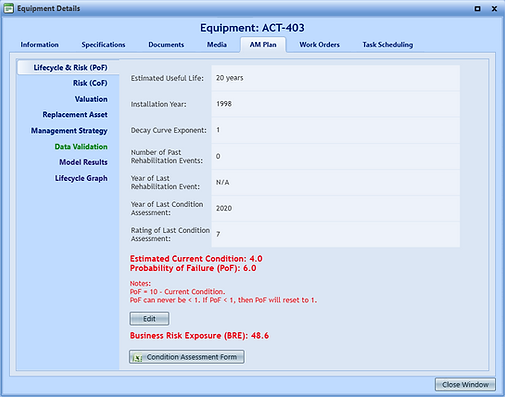
Lifecycle tab: current condition and probability of failure

Risk tab: consequence of failure and business risk exposure

Lifecycle graph: condition, risk and age of one asset over 100 years, with each planned renewal

Asset count by asset class
A plan that keeps itself current
Already have a CMMS? Keep it.
AIMS can run the Asset Management Plan alongside Lucity, Mainsaver or another maintenance system. It imports your asset data and adds the 100-year renewal forecast your CMMS doesn't provide. Some agencies use AIMS for this module alone.

100-year renewal funding forecast
The road to an Asset Management Plan
Every agency is somewhere on this road, and many already have phase 1 well underway in their GIS and maintenance system.
We can help at every step: organizing and connecting your asset data, setting lifecycle, risk and valuation parameters with your staff, choosing renewal strategies, running the forecast, and writing the plan document itself.
The finished plan covers your levels of service, the current state of your assets, your risk profile, management strategies, renewal schedules and future funding requirements.


Because the plan is connected to the systems your staff update every day, each year's forecast starts from better data than the last.
The modeling method is fully documented, so results are consistent and you can explain them to your board and in a rate study.
It can be as simple or as detailed as your agency needs, from a few asset classes to the full portfolio, and it can include planned future assets and your own budget categories.
The module was developed together with the asset management staff of a large West Coast water utility.